What is Earned Value Management (EVM)?
Published: 15-Sep-2025 Updated: 18-Oct-2025
Earned Value Management (EVM) is a project control methodology that unifies scope, schedule, and cost into a single framework. It delivers objective insights into performance and forecasts, helping managers detect risks early and make informed decisions. Today, EVM is a standard practice across industries such as construction, EPC, aerospace, IT, and infrastructure.
1. Introduction to Earned Value Management (EVM)
Earned Value Management (EVM) goes beyond traditional progress tracking by combining scope, schedule, and cost into one integrated system. Instead of relying on subjective measures like percentage completion, EVM provides quantitative answers to three critical questions:
How much work was planned?
How much work has been accomplished?
What did it cost to accomplish that work?
This structured approach allows project teams to identify cost overruns, schedule delays, and productivity issues long before they become visible in budgets or timelines. Developed in the 1960s by the U.S. Department of Defense, EVM has since evolved into a global standard, recognized by PMI’s PMBOK Guide and ISO 21508. Its adoption in EPC, oil & gas, aerospace, IT, and infrastructure projects demonstrates its versatility across complex, high-value initiatives.
Beyond monitoring, EVM strengthens stakeholder confidence by providing transparent metrics, enhances forecasting accuracy through indices like CPI and SPI, and supports proactive resource allocation. When integrated with modern tools such as Primavera P6, SAP PS, or EcoSys, EVM becomes not just a control mechanism but a strategic management practice that improves predictability, accountability, and overall project success.
2. Key Concepts, Terminology and EVM Formulas
Earned Value Management (EVM) uses a set of standard terms and metrics. These provide a common language for project teams to measure performance and forecast outcomes. Below are the most important concepts:
| Metric | Definition | Formula | Example |
|---|---|---|---|
| Planned Value (PV) | Also called Budgeted Cost of Work Scheduled (BCWS). This is the budgeted value of the work that should have been completed by a specific date. | PV = % Planned Work × BAC | By the end of Month 3, if a project was planned to achieve $5 million worth of work, the PV is $5M. |
| Earned Value (EV) | Also called Budgeted Cost of Work Performed (BCWP). This is the budgeted value of the actual work completed up to a certain point in time. | EV = % Completed Work × BAC | Completed $4M worth of work by Month 3. |
| Actual Cost (AC) | Also called Actual Cost of Work Performed (ACWP). This represents the actual cost spent to accomplish the work completed. | AC = Sum of Actual Costs | Spent $4.5M to achieve $4M worth of work. |
| Budget at Completion (BAC) | The total planned budget for the entire project. | — | EPC contract = $200M. |
| Estimate at Completion (EAC) | Forecasted total project cost based on performance. | EAC = BAC ÷ CPI | CPI = 0.9 → EAC = $220M. |
| Estimate to Complete (ETC) | Forecasted cost to finish remaining work. | ETC = BAC – EV | Remaining budgeted work = $180M. |
| Cost Variance (CV) | Difference between earned value and actual cost. | CV = EV – AC | EV = $4M, AC = $4.5M → CV = -$0.5M |
| Schedule Variance (SV) | Difference between earned value and planned value. | SV = EV – PV | EV = $4M, PV = $5M → SV = -$1M |
| Cost Performance Index (CPI) | A ratio of earned value to actual cost. Shows cost efficiency. | CPI = EV / AC | CPI = 0.89 (inefficient) |
| Schedule Performance Index (SPI) | A ratio of earned value to planned value. Shows schedule efficiency. | SPI = EV / PV | SPI = 0.8 (slow progress) |
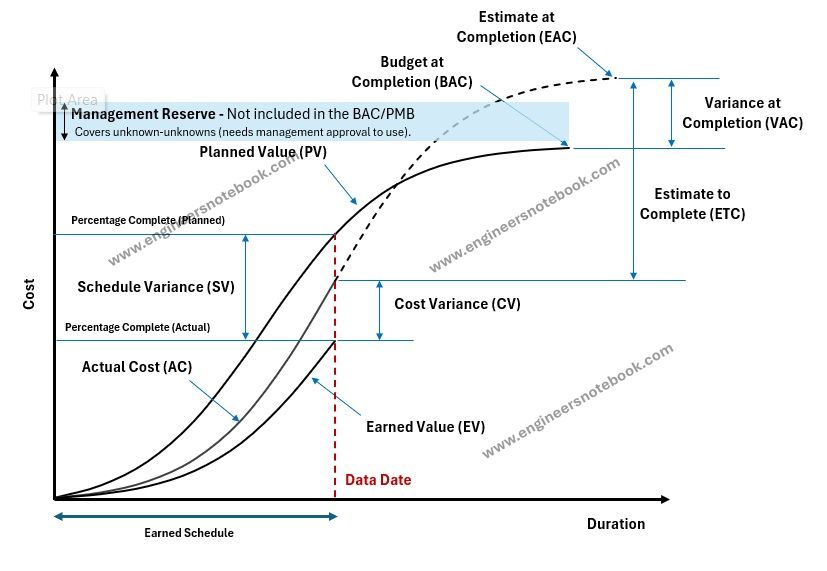
Earned Value Management (EVM) Key Formulas
| Metric | Formula | Description / Notes |
|---|---|---|
| BASE FIGURES | ||
| Planned Value (PV) (BCWS) | % of work planned × BAC | Budgeted value of work scheduled to be completed |
| Earned Value (EV) (BCWP) | % of work completed × BAC | Budgeted value of actual work completed |
| Actual Cost (AC) (ACWP) | Sum of costs incurred for completed work | Actual cost spent to accomplish completed work |
| VARIANCES | ||
| Cost Variance (CV) | EV – AC or BCWP – ACWP | Negative = over budget, Positive = under budget |
| Schedule Variance (SV) | EV – PV or BCWP – BCWS | Negative = behind schedule, Positive = ahead of schedule |
| Variance at Completion (VAC) | BAC – EAC | Projected cost variance at project completion |
| PERFORMANCE INDICES | ||
| Cost Performance Index (CPI) | EV ÷ AC or BCWP ÷ ACWP | CPI < 1 = cost overrun, CPI > 1 = cost efficient |
| Schedule Performance Index (SPI) | EV ÷ PV or BCWP ÷ BCWS | SPI < 1 = behind schedule, SPI > 1 = ahead of schedule |
| Estimate at Completion (EAC) | BAC ÷ CPI | Forecasted total project cost based on current performance |
| Method | Formula | Type / When to Use |
|---|---|---|
| Optimistic Method | EAC = AC + (BAC – EV) / 1 | Assumes future work proceeds at planned efficiency |
| Realistic Method | EAC = AC + (BAC – EV) / CPI | Based on CPI only — current cost performance continues |
| Pessimistic Method | EAC = AC + (BAC – EV) / (CPI × SPI) | Based on both CPI & SPI — accounts for cost & schedule issues |
| Method | Formula | Type / When to Use |
|---|---|---|
| Optimistic Method | ETC = (BAC – EV) / 1 | Assumes future work proceeds at planned efficiency |
| Realistic Method | ETC = (BAC – EV) / CPI | Based on CPI only — current cost performance continues |
| Pessimistic Method | ETC = (BAC – EV) / (CPI × SPI) | Based on both CPI & SPI — accounts for cost & schedule issues |
3. Benefits & Limitations of EVM
Benefits of EVM in EPC Projects:
Unlike its costs, which can be measured directly, the benefits of Earned Value Management (EVM) are less tangible and often debated. Assessing whether the advantages outweigh the effort is subjective, yet its expanding use across government agencies, industries, and international organizations highlights its growing value.
For years, critics argued that EVM was costly and relevant only to defense projects. Today, however, it is widely acknowledged as a practical and effective management tool for projects of varying scale and complexity.
Key Advantages of EVM
The most significant strength of EVM lies in its support for Management by Exception (MBE). Once a baseline is established, managers can concentrate on deviations rather than routine progress. If the project remains aligned with the plan, no additional intervention is required.
Other notable benefits include:
Data‑driven decision‑making through performance‑based monitoring.
Early detection of risks and emerging issues.
Proactive corrective measures before problems escalate.
Objective project status reporting, reducing reliance on subjective judgment.
Clear visibility into the cost impact of current challenges.
Integrated reviews that inform budget and resource allocation.
Stronger accountability to leadership and stakeholders.
Improved communication across global projects through standardized metrics.
Limitations and Challenges of EVM:
Although Earned Value Management (EVM) delivers powerful insights, it is not a universal solution. Its effectiveness depends on how it is applied, and several limitations should be recognized:
Diagnostic, not prescriptive: EVM highlights variances and issues but does not provide the corrective measures needed to resolve them.
Cost control visibility only: It cannot prevent overruns; it simply signals them early so managers can respond.
Dependence on planning discipline: Reliable results require detailed and systematic cost and schedule planning across all work packages.
Focus on quantity, not quality: EVM measures progress in terms of scope and cost but does not assess technical performance or deliverable quality, which must be tracked separately.
Not a substitute for management: EVM is a tool that supports project oversight, but it cannot replace sound project management practices or guarantee success.
4. Earned Value Management Across Project Phases
Earned Value Management (EVM) is most valuable when applied systematically across all phases of a project. By integrating cost, schedule, and scope information at each stage, project managers gain early insights and can make informed decisions to keep the project on track.
1. Planning Phase
Purpose: Establish the Performance Measurement Baseline (PMB) by defining scope, schedule, and cost for each Work Breakdown Structure (WBS) element.
EVM Activities:
- Create WBS with cost and schedule estimates
- Assign resources and link costs to activities
- Determine milestones and key deliverables
Example: A construction project defines all major deliverables and allocates budget to each task, forming the baseline against which progress will be measured.
2. Execution Phase
Purpose: Monitor work completion and compare it against the plan.
EVM Activities:
- Measure actual work completed (Earned Value, EV)
- Track Actual Cost (AC) and calculate Cost Performance Index (CPI) and Schedule Performance Index (SPI)
Example: After one month, a highway project reports EV of $500,000 and AC of $480,000. The CPI = 500,000 / 480,000 = 1.04, indicating cost efficiency.
3. Control Phase
Purpose: Take corrective action when variances occur.
EVM Activities:
- Analyze Cost Variance (CV = EV – AC) and Schedule Variance (SV = EV – PV)
- Forecast Estimate at Completion (EAC) and To-Complete Performance Index (TCPI)
- Adjust resources, schedule, or scope to recover variances
Example: A software project detects an SV of -$20,000. By reallocating developers from completed modules, the project recovers the schedule without additional cost.
4. Closing Phase
Purpose: Evaluate overall performance and capture lessons learned.
EVM Activities:
- Compare final EV, AC, and PV against baseline
- Assess CPI and SPI trends for future projects
- Document insights and update organizational process assets
Example: At the end of a bridge construction project, SPI = 1.01 and CPI = 0.98, confirming the project met schedule targets but slightly exceeded costs. Lessons learned guide estimations in the next project.
5. Best Practices and Common Mistakes
Best Practices for Implementing EVM in EPC Projects
Define a Clear Work Breakdown Structure (WBS): Manageable work packages with assigned budgets and schedules ensure accurate measurement of earned value.
Establish Accurate Baselines: Realistic cost and schedule baselines are critical for meaningful metrics.
Integrate EVM into Project Processes: Link EVM with scheduling, cost control, procurement, and reporting to maintain data consistency.
Assign Responsibility: Clear accountability for each work package helps manage scope, schedule, and cost effectively.
Collect and Validate Data Regularly: Timely, accurate progress and cost reporting is essential.
Monitor Key Metrics: Track CV, SV, CPI, and SPI; set thresholds for corrective actions.
Conduct Periodic Performance Reviews: Stakeholder reviews help identify trends, risks, and required adjustments.
Continuous Improvement: Capture lessons learned and refine EVM practices for future projects.
Training and Awareness: Educate all team members on EVM principles and metrics interpretation.
Use Appropriate Tools: Enterprise tools like Primavera P6, SAP PS, EcoSys, or lightweight Excel-based templates depending on project scale.
Common Mistakes to Avoid:
Using inaccurate or delayed data
Treating EVM as a separate reporting exercise
Ignoring scope changes or ambiguous work packages
Following these best practices ensures proactive project control, accurate forecasting, and enhanced stakeholder communication.
6. Case Study: EVM in a Construction/EPC Project
An EPC contractor is executing a gas processing facility expansion that includes a new compressor station, cryogenic unit, and associated pipelines. The project budget is $120M with a planned duration of 24 months. By Month 12, civil works, structural steel, and partial mechanical installation are underway. Management wants to assess mid‑project performance using Earned Value Management (EVM) to forecast cost and schedule outcomes.
Project Data (Month 12)
- Budget at Completion (BAC): $120M
- Planned Value (PV): $60M
- Earned Value (EV): $52M
- Actual Cost (AC): $70M
EVM Calculations
- Cost Variance (CV): CV = EV − AC = 52 − 70 = −18M → Significant cost overrun
- Schedule Variance (SV): SV = EV − PV = 52 − 60 = −8M → Behind schedule
- Cost Performance Index (CPI): CPI = EV ÷ AC = 52 ÷ 70 ≈ 0.74 → Poor cost efficiency
- Schedule Performance Index (SPI): SPI = EV ÷ PV = 52 ÷ 60 ≈ 0.87 → Progressing slower than planned
- Estimate at Completion (EAC): EAC = BAC ÷ CPI = 120 ÷ 0.74 ≈ 162.16M → Forecasted total cost
- To‑Complete Performance Index (TCPI): TCPI = (BAC − EV) ÷ (BAC − AC) = (120 − 52) ÷ (120 − 70) = 68 ÷ 50 = 1.36 → Remaining work must be executed at 36% higher efficiency than current performance to meet the original budget.
Interpretation
The analysis reveals the project is both over budget and behind schedule at the halfway mark. A CPI of 0.74 indicates severe cost inefficiency, while an SPI of 0.87 shows slower progress than planned. The forecasted completion cost of $162M exceeds the baseline by over 35%, raising concerns about profitability and client satisfaction.
Management must take corrective actions such as:
- Reallocating resources to critical path activities.
- Reviewing subcontractor productivity and procurement delays.
- Implementing tighter cost controls and renegotiating vendor terms.
- Revising the schedule baseline to reflect realistic progress.
7. Conclusion: Why EVM Matters in EPC Projects
Earned Value Management (EVM) transforms project oversight from passive reporting into proactive control. By integrating scope, schedule, and cost, EVM provides quantitative insights that help stakeholders detect deviations early, forecast outcomes, and implement corrective actions.
For greenfield EPC projects, EVM ensures that multi-billion-dollar investments in refineries, LNG terminals, and petrochemical plants are delivered on time and within budget. For brownfield projects, it safeguards critical shutdowns, revamps, and maintenance activities, minimizing financial and operational risks.
When implemented using best practices, supported by the right tools, and aligned with recognized global standards, EVM enhances:
- Predictability: Accurate forecasting of project completion and costs
- Transparency: Clear performance metrics for all stakeholders
- Decision-Making: Data-driven corrective actions and resource allocation
In competitive, high-risk industries like oil and gas, EVM is not optional—it is a project control necessity. It enables project teams to move from reactive problem-solving to strategic performance management, improving the likelihood of project success and maximizing return on investment.